Franck Carnero is MAIF’s Director of Mission and Impact; he discusses the integration of climate considerations within the company.

An interview with Franck Carnero conducted by Dorothée Browaeys, Chair of Vivøices.
Franck Carnero has been MAIF’s Director of Mission and Impact since 2019. In this role, he coordinated MAIF’s transformation into a mission-driven company in 2020.
1. How does MAIF currently take the environment into account? What tools and specific internal organisational structures does it use?
MAIF began assessing its sustainability in the mid-2000s. However, this focus on CSR intensified when we became a ‘mission-driven company’ in 2020. Of the five statutory objectives, the last two focus respectively on ‘contributing to the ecological transition’ and ‘promoting the development of business models committed to achieving positive impacts’.
Our Mission Committee supports this drive for change. Under the leadership of Alain Grandjean (from the Fondation pour la Nature et l’Homme) and subsequently Ghislaine Verrhiest-Leblanc, a specialist in risk prevention and risk culture, we have been able to incorporate climate-related issues into the committee’s remit. We have recently appointed Pierre Deroubaix from ADEME to champion these issues within our Mission Committee.
Our 2023–2026 strategic plan includes policies for mitigating and adapting to climate change (adaptation ties in with prevention issues). This involves all business lines. We have rolled out an employee onboarding programme to raise awareness of climate change. Teams are now able to carry out their own carbon assessments and propose at least one action, so as to ‘learn by doing’ and translate what they have learnt into operational projects, in a way that is appropriate for the men and women who make up our internal MAIF community. We place the emphasis on taking action, in the belief that we must move from an individual mindset to a collective approach. We have observed during trials that certain workshops can trigger eco-anxiety: however, fear and stress are not sufficiently motivating in the long term, which is why the programme has been developed specifically for MAIF with a focus on positive engagement.
Participation in the modules we have developed in-house and team dynamics are factored into our performance appraisals and profit-sharing schemes. We are therefore establishing a link between performance and environmental contributions.
2. MAIF is developing a 10-year vision with a long-term commitment. Could you explain how this approach works, the added value it creates, and how stakeholders are consulted as part of this process?
MAIF has just finalised its 10-year vision by bringing together around fifty activists and employees, selected at random, alongside contributions from over a thousand members. As the very foundation of the mutualist model, this bond stands out as the natural response to new challenges. Thus, the bond that connects people to one another and to the living world will be the driving force for action over the next ten years. The aim will be to rethink the long-term relationship with members, to strengthen internal cooperation, to develop solutions that combine insurance and prevention, and to foster the company’s commitment to the planet and society. This is a way of embodying the strength of the collective in the face of uncertainty.
We draw on a four-part framework – a sort of four-axis radar – to quantify our value creation. This compass enables those within the company, whether involved in operational or strategic decision-making (at any level of decision-making), to assess the impact of ongoing projects. This four-part framework includes various criteria, such as the satisfaction of our members, the fulfilment of our employees (in terms of empowerment, accountability and autonomy) and our contribution to the wider society (including care for the planet), in addition to the traditional performance metrics found in any organisation.
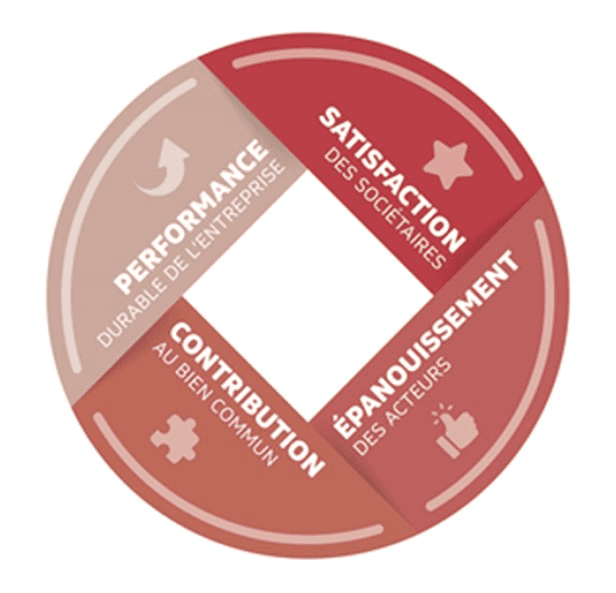
The MAIF four-part framework
The structure of our statutory objectives is aligned with these last three areas. We have our own approach to the issue of performance analysis, which we believe must be multifaceted, combining financial requirements with those of sustainability.
We aim to make further progress on the issue of value creation. For example, we are seeking to enhance our measurement of return on investment by giving greater weight to social and environmental contributions…
3. How are you organised internally to prioritise sustainability?
Today’s leading sectors can draw on dual sets of skills (traditional sector-specific expertise and sustainability know-how applied to their field). This is the case, for example, with sustainable finance and sustainable procurement. We do not wish to treat sustainability issues as a separate matter. That is why we have been strong advocates of sustainability reporting, to promote ‘double materiality’ within large companies (which takes into account not only the risks posed to the company by changes in its environment, but also the risks the company itself poses to its key stakeholders). The European CSRD enables the traceability of impacts and provides useful clarity for decision-making. For example, it provides information on impacts on the climate, biodiversity, water, soil and so on. Yet, in their risk reports, large companies rank biodiversity high on their list of priorities. The collapse of the living world threatens our businesses and our production systems far more than we might intuitively realise!
Beyond the impacts themselves, it would be useful to be able to quantify the benefits our impact initiatives deliver. Five years ago, we worked (with the help of an external consultancy) to establish methods for estimating the value of our environmental and social contributions. For example, we assessed the benefits generated by members’ trust and loyalty, and the advantages derived from the quality of our services. However, this is complex to model and time-consuming, so it is not an assessment that we update every year!
We firmly believe in the importance of reciprocity, which forges a link between the experience we provide for our employees internally and the quality of the support and attention they can then offer to our members. There is a mutual benefit when we promote the values of trust and the quality of relationships, but we do not devote a great deal of resources to providing a detailed econometric demonstration of these connections.
4. Could you explain what led you to develop the ‘ecological dividend’ model, the value it creates for MAIF (customers, partners, teams, etc.) and how it is redistributed?
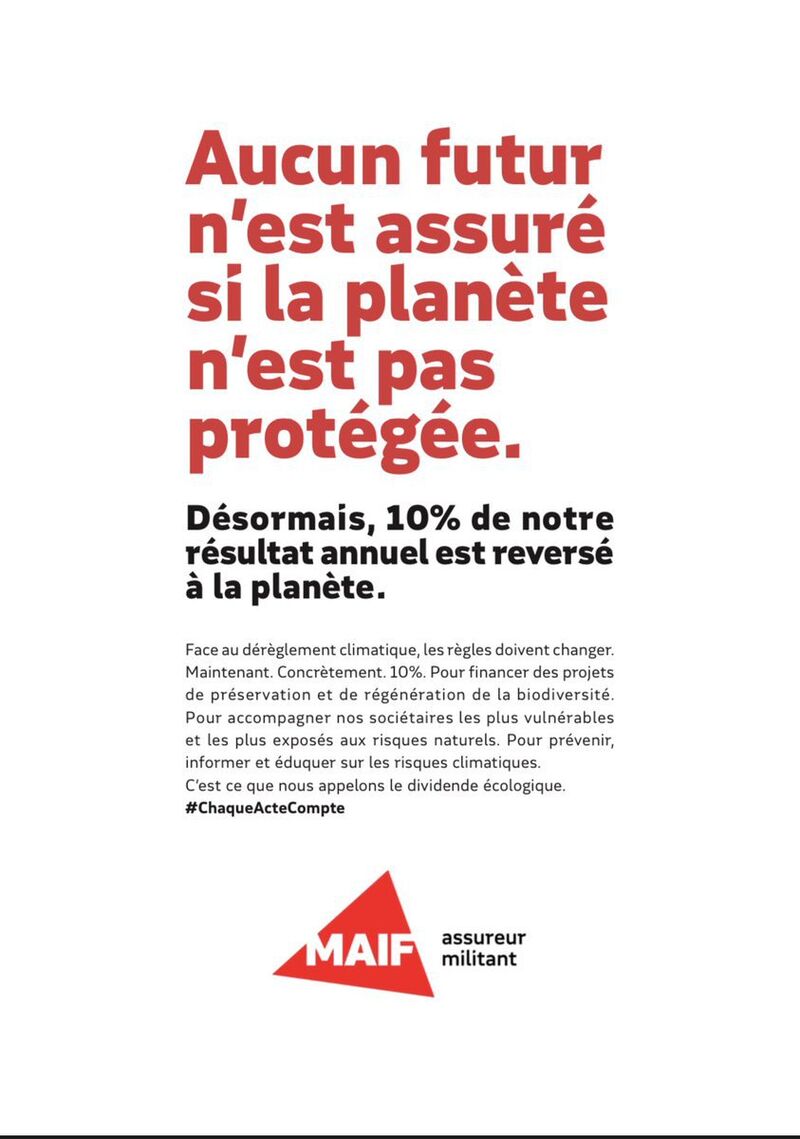
Yes, the principle behind the ecological dividend is to reallocate 10 per cent of our consolidated profits to issues related to climate change.
The first area focuses on funding ecosystem restoration initiatives, using nature-based solutions, such as upstream of Saintes where grasslands have been restored to accommodate flooding from the Charente river, thereby reducing damage downstream. In Bourg-en-Bresse, we also have a project to re-meander the River Reyssouze. For these initiatives, we aim both to assess the gains in terms of biodiversity and to measure the reduction in the impact of flooding on residents, as well as improvements in quality of life.
The second focus area is dedicated to solidarity initiatives for members. We therefore cover the cost of vulnerability assessments in areas particularly exposed to climate-related hazards, as well as part of the cost of work carried out by private individuals to make their homes more resilient to potential disasters (e.g. installing cofferdams or disconnecting the drainage system from the sewage network).
5. How do you incorporate risk prevention into your approach in order to help ensure the insurability of a liveable future?
We strongly believe that climate change will require insurers to get involved at an early stage in order to prevent premiums from skyrocketing. But the problem is that we sometimes lack data to prove just how effective prevention really is!
We are therefore involved in Geoya, a joint venture between Generali, Société Générale Assurances, Sixence, and Saretec (a specialist in post-claim assessment). The aim is to explore useful services that can be rolled out to promote prevention and to validate a potential business model.
Our commitment to taking a long-term view, grounded in scientific research, has also led us to become heavily involved in the PARI Chair (Research Programme on the Understanding of Risks and Uncertainties), which will, in particular, help us to better understand the challenges of insurability and the impacts of climate change on solidarity – key issues for a company such as MAIF, which is committed to the principles of mutualisation.
La MAIF
As the leading insurer in the voluntary sector and the sixth-largest provider of motor and home insurance for private individuals, MAIF meets all the needs of more than 4 million members (property insurance, personal protection, assistance, savings, credit, etc.), with a turnover of nearly 6 billion euros in 2025. It is organised on a democratic basis: members elect their delegates, who in turn elect the members of the board of directors.
Photo credits: Mélanie CHAIGNEAU – MAIF.


