Giving Nature a new role in business, a key approach to reconciling economics with living ecosystems.

Is it possible to view financial returns as a means to an end, rather than an end in itself?
Yes, say the advocates of steward-ownership, a movement comprising more than 3,000 companies. Today, however, we need to adapt this model so that corporate ownership serves the interests of nature.
The advantages of steward ownership
By placing part of the capital in the hands of a foundation that cannot be sold or bought back, steward-ownership enables companies to protect themselves against speculation and undesirable changes to their capital structure. This is precisely what Buurtzorg, a Dutch company also known for its self-organised management, has done. Steward-ownership can also serve a broader corporate strategy: at Mozilla, for example, the aim is to safeguard a corporate purpose; and at Carlsberg, it is to ensure the long-term presence of a shareholder with a long-term perspective.
In practical terms, the principles underpinning steward-ownership call for a separation, within the shareholder base, of economic and political prerogatives. On the one hand, financial investors are thus entitled only to economic prerogatives, consisting of receiving dividends. On the other hand, the so-called political prerogatives (strategy formulation, choice of executives, etc.) are held by ‘stewards’, that is to say, by guardians of the company’s long-term vision.
The models of steward ownership
There are various legal structures and governance models for implementing this approach. Most commonly, this involves irrevocably transferring a share of the company’s capital to a shareholder foundation. Two scenarios are then possible. Either the foundation holds a majority stake in the capital, in which case the transaction takes on a philanthropic character as an equal share of dividends is redirected towards initiatives of general interest. Or the foundation holds a minority stake in the capital, which involves transferring a ‘golden share’ to it in order to guarantee its influence over the company’s strategy.
A golden share is a share carrying special rights. To safeguard the company’s mission, this share therefore grants the foundation a right of veto over certain strategic decisions. Whilst the scope of this veto is to be determined with the company on a case-by-case basis, it usually covers matters such as: changes in share capital, the sale of the company, amendments to the articles of association, changes to the company’s purpose, the distribution of shareholder rights, the appointment of directors, etc.
A model to reimagine to put impact front and centre
As representatives of this movement point out, steward-ownership is not at odds with growth or profitability strategies. Quite the contrary, given that companies such as Novo Nordisk, Bosch, OpenAI and Ikea have entrusted part of their capital to foundations. Yet these few examples should give us pause for thought. Indeed: whilst steward-ownership appeals to companies with a clear social or environmental mission (e.g. Buurtzorg or Ecosia), others are, on the other hand, regularly criticised for their social or environmental impacts (e.g. OpenAI or Ikea).
In other words, whilst steward-ownership serves a company’s long-term interests and allows part of the dividends to be channelled into projects of public interest, there is no guarantee that this stewardship is beneficial for other stakeholders, such as people or the planet. Faced with the limitations of the traditional model, steward-ownership is therefore beginning to take on a new form, which we suggest calling “nature-ownership”.
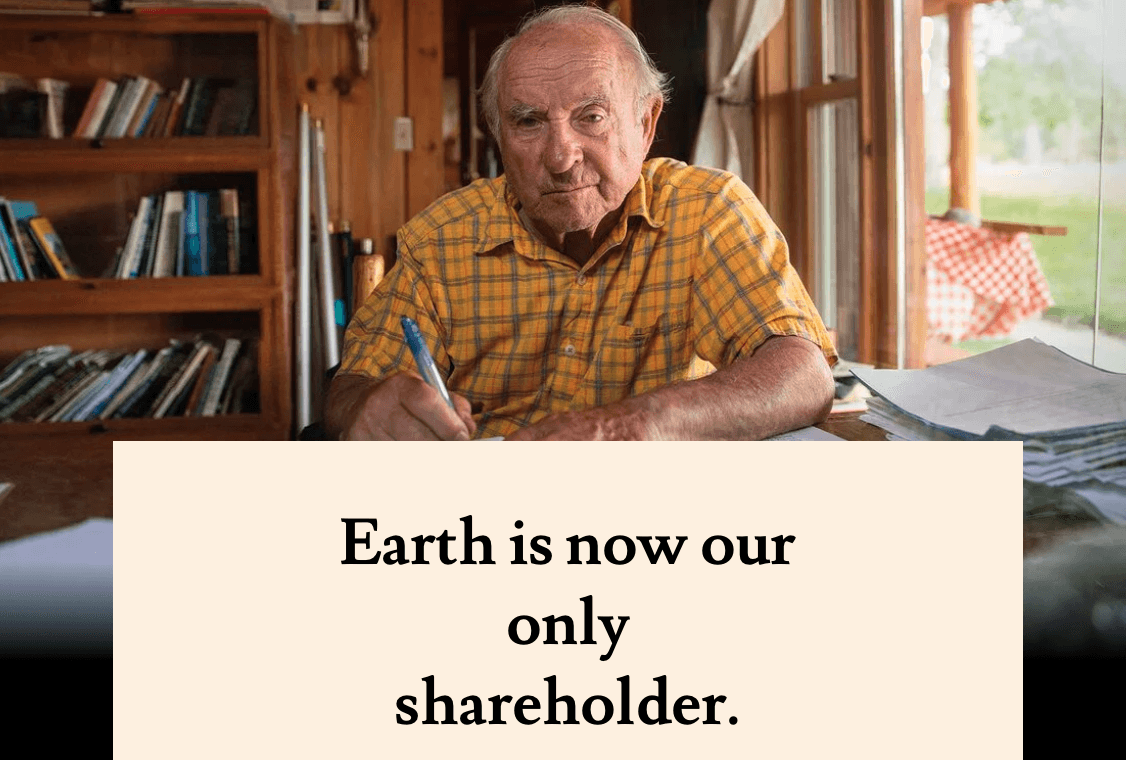
Perhaps the best-known example is that of Patagonia, which in 2022 chose to transfer 98% of its capital to an environmental protection foundation. This example is, however, incomplete, as it was the economic control that was transferred to this foundation. In other words, the political prerogatives (decision-making power) remained in the hands of the founder and his family, who hold the 2% of shares conferring voting rights on corporate strategy.
We believe that the case of Norsys in France is more faithful to the concept of nature ownership, as the foundation, which holds 10% of the company’s capital, in this instance has both economic and political powers. In practical terms, this means that the foundation has voting rights on the board of directors, through a nature director specifically recruited to fulfil this role, and supported by a scientific advisory board. Furthermore, this director even has a veto right, making this company a pioneer in the field of green shares.
Nature-Ownership, the way to follow
We believe that modernising steward-ownership is essential to adapt this tool – and, more broadly, corporate governance – to the societal and environmental challenges of the 21st century. In France, the legal framework actually allows for such modernisation, as highlighted in studies published by Prophil, even though some legal uncertainties remain regarding the powers available to shareholder foundations.
To find out more, please do not hesitate to contact us, or to consult our publications on the topic of “nature as a shareholder”.