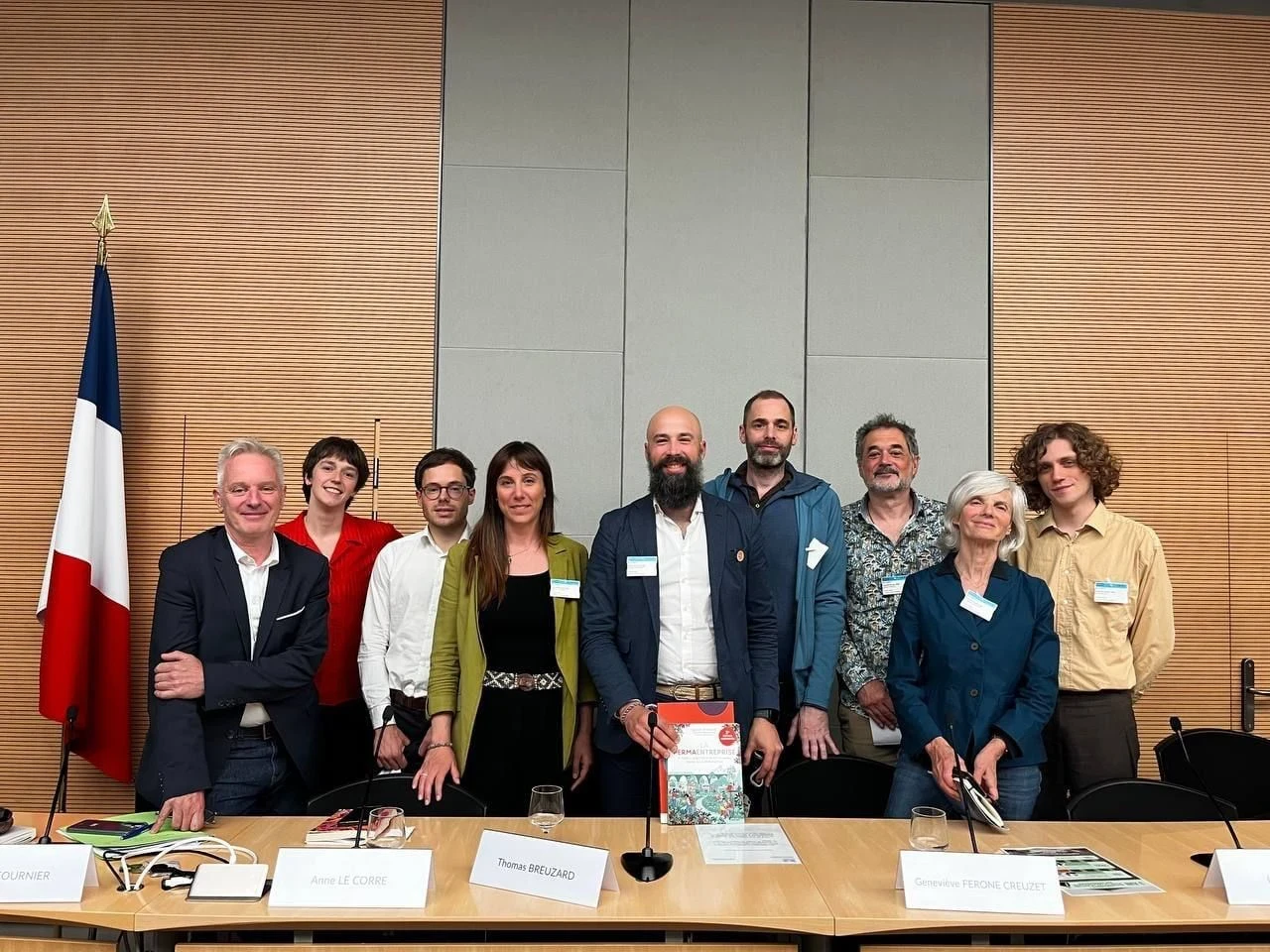
Benjamin Allegrini, Chairman of Alkïos and Spygen, and co-founder of the École des vivants with Alain Damasio. He represents the ‘living’ at Bayard.

Interview with Benjamin Allegrini by Dorothée Browaeys, President of Vivøices.
Benjamin Allegrini is President of Alkïos and Spygen, and co-founder of the École des vivants with Alain Damasio. He represents the living world at Bayard.
What did the Bayard group expect when it asked you to join its Mission Committee?
In 2023, Bayard wanted to bring a naturalist onto its Mission Committee. At the time, in companies generally, the environmental question was almost entirely taken up by climate. When people talked about impact, it was all about CO2. Biodiversity stayed in the background, as something to adjust later. The fact that I run Spygen, which is itself a mission-driven company (entreprise à mission), probably helped too: we at least spoke the same institutional language.
At first, my role was mainly to put natural environments back at the center, or at least to make sure they weren't forgotten. Not forgetting the fauna, the flora, the ecosystems as networks of relationships, not just as a list of species. Reminding people what biodiversity really is and what it means in practice, with all its interdependencies… These subjects were far less well understood than global warming. Then we opened up the question of the negative externalities specific to publishing: making books and newspapers requires forests, wood, paper. And forests, I insist, are not a carbon sink. They are so much more than that. They are a living environment, a web, relationships that make us who we are.
As a kind of spokesperson for Nature on the Mission Committee, how do you speak for Nature? Using which criteria, which references, which compasses?
First, I've been shaped by decades of fieldwork and reading in ecology. That's how a real relationship with the living world is built. But in the specific setting of a mission committee, an institutional process, some philosophers offer something useful: handholds, ways of phrasing things that let you talk to people who don't come from that world at all. I'm thinking of Bruno Latour and the idea of the territory we depend on, Baptiste Morizot and his "attuned regard" (égards ajustés), Vinciane Despret and her way of living as a bird. These are compasses, not systems. Not a substitute for naturalist knowledge, but bridges to other professional cultures.
I avoid talking about "Nature" in general. It's an abstraction that slips away. I always bring it back to a specific territory: which country, which region, which place? So that we're aware of a real situation, not a concept. Bayard has in fact recommended that its employees take part in the Biodiversity Collage (Fresque de la biodiversité), and that's where it starts.
In January 2025, La Croix made ten commitments to cover ecological challenges, marking ten years since the encyclical Laudato Si'. The "Parlons écologie" ("Let's Talk Ecology") initiative was launched with an expert committee made up of Cécile Renouard, philosopher at ESSEC and founder of the Campus de la Transition, Valérie Masson-Delmotte for paleoclimatology, Arnaud Gossement for environmental law, and myself. We met quarterly to report on what was happening on the ground and to tackle burning issues such as AI or the relationship between economics and ecology.
Within the Mission Committee itself (management, CSR, staff representatives, other external figures…), we worked for example on making value chains visible: paper, inks, cardboard. Understanding where things come from in order to grasp the real impact of the business. The priority is to help people grasp our interdependencies so we can reduce our indifference.
What effects have your presence and your contributions had on the Mission Committee? Can you give some examples…
Above all, my presence has made the topics concrete and raised awareness of the living world. A kind of acculturation to natural environments, which are often missing from people's minds, even among people of goodwill. I insisted a lot that the people I spoke with understand how important interactions are in a forest or a river, for example. It's not only a question of stocks or species. It's a question of relationships.
As a naturalist, I was also asked to define concrete objectives needed for assessment, and to help define indicators for the mission-driven company status: the Biodiversity Collage for teams, field reports, and awareness-raising for La Croix journalists.
What are the difficulties or gaps in giving Nature a real presence? What could be improved?
I'm truly happy with what I've been able to do at Bayard, because it really resonates there. I didn't feel any resistance or pushback. And I know that change takes time.
On value chains, Bayard has already made well-considered choices: an FSC requirement for supplier forests, and removing or reducing packaging for both books and press titles. On inks, lower ink coverage on some titles to reduce the volumes used. On "biodiversity and the economy," we're starting to better measure how much we depend on it: the Institut Montaigne has shown that 40% of assets and 80% of GDP rely on biodiversity. It's no longer a matter of conviction. It's an accounting reality.
What shifted me most in this experience was being able to contribute, even modestly, to a new business culture connected to the living world, not just to performance. It's an awakening of a different kind.